Share your ingredient, application, or formulation challenge. Our technical team can help with specifications, solubility, delivery systems, and supporting documentation.
Turn Complex Ingredient Questions Into Clear Technical Decisions
Technical & Formulation Team
From specifications and solubility to formulation compatibility and advanced delivery systems, our technical team can help you evaluate the right ingredient approach for your application and target market.
Technical Support for Your Application
Specification & grade selection
Solubility & formulation compatibility
Liposomal, microencapsulated & water-soluble systems
Phytochemicals are naturally occurring compounds that plants produce for their own use, whether to defend against pests and pathogens, build pigments or cope with UV light and other environmental stress. Flavonoids, carotenoids, phenolic acids, terpenoids and alkaloids are all phytochemical classes. Unlike vitamins and minerals, phytochemicals are not classed as essential nutrients.
For a product developer or buyer, the textbook definition is the easy part. The harder question arrives at the quotation stage: is the material on offer a milled botanical, a ratio extract, a standardized extract or a single isolated compound? Each carries different specifications, test methods, cost drivers and documentation risks. This guide explains what phytochemicals are, how the main classes map onto real ingredients, and what to confirm before you request a quote.
What Phytochemicals Are, and What They Are Not
Phytochemicals (from the Greek phyto, “plant”) are chemical compounds made by plants, mostly as secondary metabolites. They are not part of the basic machinery of growth, such as sugars, amino acids and structural lipids. They do work the plant still needs: screening tissue from UV light, deterring herbivores, attracting pollinators and resisting microbes.
Three points prevent confusion in supplier conversations:
They are not essential nutrients. Vitamins and minerals have established requirements. Phytochemicals generally have no dietary reference intake.
“Phytonutrient” and “phytochemical” are used loosely. Consumer content treats them as synonyms. A specification should name the individual compound, its CAS number and the botanical source.
“Phytochemical” is not a regulatory category. Depending on the market and intended use, the same compound may be handled as a dietary ingredient, a food additive or a cosmetic ingredient. Health-related claims are governed separately in each jurisdiction, and this article makes none.
The Main Classes of Phytochemicals
Researchers group phytochemicals by chemistry. The broad families include phenolic compounds (flavonoids, phenolic acids, stilbenes), terpenoids (including carotenoids), alkaloids, sulfur-containing compounds such as glucosinolates, saponins and phytosterols. Each family brings its own extraction methods, stability problems and analytical tests.
Flavonoids make the clearest teaching case for buyers. They are commonly traded as purified powders with a stated assay, and they expose every sourcing question discussed below.
“Flavonoid” is far too broad a term to buy against. Individual compounds behave differently, and the examples below show how.
Citrus flavanones. Flavanones are the subgroup behind most citrus-peel ingredients. Hesperidin (CAS 520-26-3) is a glycoside of the aglycone hesperetin. Citrus-derived hesperidin powder is usually specified by botanical source, such as Citrus aurantium, and by declared hesperidin percentage. Glycosides and aglycones are different compounds with different solubility behavior, so hesperidin and hesperetin cannot be swapped on a purchase order.
Easily confused compounds. Neohesperidin (CAS 13241-33-3) is another citrus flavanone glycoside. Neohesperidin 95% powder is a different material from neohesperidin dihydrochalcone (NHDC), the high-intensity sweetener. The names are close enough that an RFQ saying only “neohesperidin” can attract a quote for the wrong material.
Flavones. Apigenin (CAS 520-36-5) is the flavone buyers ask about most. It occurs in celery and parsley, and chamomile-derived apigenin is one commercial route to a concentrated powder.
Flavonols. Kaempferol (CAS 520-18-3) sits in the flavonol subgroup alongside quercetin. Kaempferol powder is described by chemical class and appearance, so ask the supplier which botanical source and extraction route produced each lot.
Phytochemical, Plant Extract or Botanical Powder: What Are You Actually Buying?
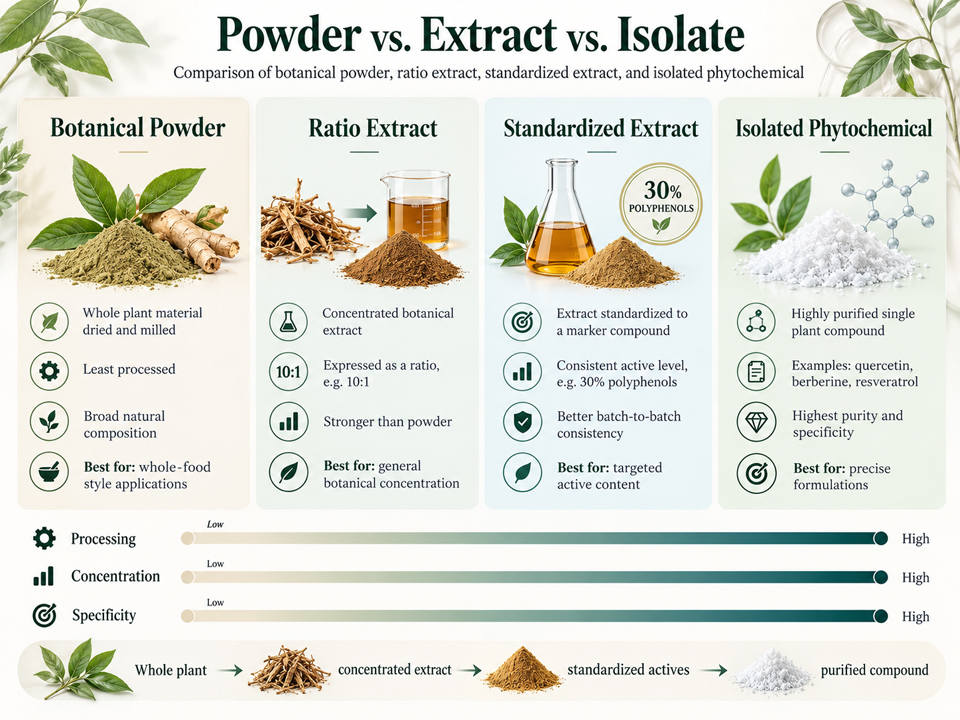
A phytochemical ingredient reaches a buyer in one of four commercial formats, and the format decides what the number on the specification sheet means.
Precise dosing, premixes, analytical or research use
The most frequent error is treating these formats as interchangeable. A “10:1” ratio nominally means ten parts of raw material per part of extract. It does not say how much hesperidin, apigenin or any other compound the powder contains. If your label will state a compound content, you need a standardized extract or an isolate, bought against a named method.
Why “98%” Does Not Complete a Specification
The common shortcut is to treat the highest assay as the best ingredient. That assumption needs qualifying. A purity figure answers a narrow question: how much of one named compound a laboratory found, by one method, in one lot. By itself it says nothing about identity, botanical source, residual solvents, solubility or suitability for the target market.
Four gaps appear repeatedly.
Method. HPLC separates compounds before measuring them, so the result is specific to the named compound. UV spectrophotometry measures absorbance at a wavelength, so other compounds that absorb there can inflate the figure. A listing that names several methods still needs the COA to state which one produced the assay value.
Form and solubility. A peer-reviewed review of naringin describes it as slightly soluble in water, about 1 mg/mL at 40 °C, with limited bioavailability linked to low solubility and permeability. A 98% pomelo peel naringin lot can therefore still be a poor fit for a ready-to-drink beverage or a fast-dissolving format. Formulation trials answer that question. The assay percentage does not.
Botanical origin. The same compound can come from different plants. Apigenin from celery extract and the chamomile-derived material are both apigenin on paper, yet each source brings different co-extracted constituents and a different documentation trail. Celery is also among the 14 allergens that must be declared under EU food-information rules, so ask whether allergen status has been assessed for your destination market. Ask which species and plant part were used.
Grade. Listings for the same compound may be positioned for supplements, cosmetics or research use. Confirm the intended grade in writing. Do not infer it from the compound name or a product photograph.
In practice, a documented 95% by validated HPLC, with confirmed identity and known solubility behavior, is usually a safer purchase than an undocumented 98%. Higher assays generally cost more because they need further purification. Pay for the extra points only when the application demands them, for example a narrow dose tolerance or analytical reference use. Otherwise, put the budget into documentation and testing.
A Recurring Buyer Problem: Identity Testing Versus the COA
A thread on the IFSQN food-safety forum shows how this plays out for newer supplement companies. A quality contact at a small firm described an audit non-conformance. The company verified identity when it approved a supplier, but the auditor wanted identity confirmed on incoming material, and the firm worried about the cost of testing every batch. Replies drew a line between identity and everything else:
One participant said identity must be tested for every lot, while other attributes such as potency could be reduced once the material was qualified.
Replies judged pH and sensory checks alone insufficient.
FTIR was suggested as a practical identity method, though the original poster found per-lot quotes expensive.
These are practitioner opinions, not regulatory guidance, and one reply acknowledged the rules leave room for interpretation.
The underlying rule is 21 CFR 111.75. Under the FDA’s dietary supplement cGMP requirements, a manufacturer must conduct at least one appropriate test or examination to verify the identity of any component that is a dietary ingredient before using it, unless FDA grants a petition for alternative testing. A supplier’s certificate of analysis can be relied on for other components only if the manufacturer first qualifies the supplier by confirming its results, documents how it did so, periodically re-confirms the COA and has quality personnel approve the basis. The COA itself must describe the test methods, limits and actual results.
That rule applies to firms making dietary supplements for the US market. The EU, Canada and other regions set their own expectations. The sourcing consequence is practical in any market: a supplier that makes identity verification easy, with reference chromatograms or spectra, consistent lots and retained samples, saves its customers audit findings.
What Drives the Price of a Phytochemical Powder?
Price per kilogram reflects more than the percentage on the label. The main drivers are:
how concentrated the compound is in the chosen plant part;
the number of extraction and purification steps;
solvent recovery and residual-solvent control;
the assay level required;
particle size or solubility work;
the testing and documentation tier;
order size, packaging and freight.
Lowest unit price does not equal lowest total cost. A cheaper lot that fails incoming identity testing triggers retesting, supplier re-qualification and schedule delay, none of which appear on the quotation.
How to Evaluate a Phytochemical Supplier
Judge suppliers on what they will put in writing:
Source transparency. Can they name the botanical species, plant part and extraction solvent, and tell you if any of these change?
COA quality. Does the COA state the method, limits and actual results, as the regulation expects, rather than a bare percentage?
Lot consistency. Will they provide COAs for two or three consecutive lots, plus a reference chromatogram?
Sample integrity. Is the sample drawn from the same lot as the COA you were sent, with a retained portion?
Change control. Will they notify you before switching raw material origin or solvent?
Grade clarity. Is the intended grade (supplement, food, cosmetic, research) stated in writing?
Independent verification. Do they accept testing by your own laboratory?
What Should Buyers Specify Before Requesting a Quote?
A supplier can quote accurately only against a defined material. Include:
Compound and CAS number, plus any exclusion that matters (for example, not the dihydrochalcone, not the aglycone).
Format: standardized extract or isolate (ratio extracts do not define compound content).
Minimum assay and required analytical method.
Botanical species, plant part and extraction solvent preferences.
Intended grade and destination market, with allergen and residual-solvent requirements.
Physical specifications: particle size or mesh, solubility or dissolution needs, and bulk density if the powder will be encapsulated.
Contaminant limits: heavy metals, microbial counts and pesticide residues where relevant.
Documents: per-lot COA, technical data sheet, SDS, specification sheet and a reference chromatogram.
Commercial terms: first-order and annual volume, MOQ, packaging, destination, delivery schedule and sample quantity.
Sending these fields up front shortens the quotation cycle and exposes mismatches while they are still cheap to fix. Request a sample from the same lot the COA describes, and verify identity on receipt before approving a production order.
Frequently Asked Questions
1. What are phytochemicals in simple terms?
Phytochemicals are naturally occurring compounds made by plants, including flavonoids, carotenoids, phenolic acids and terpenoids. Plants use them for defense, pigmentation and stress protection. Unlike vitamins and minerals, they are not classed as essential nutrients.
2. Are phytochemicals and phytonutrients the same thing?
In most consumer and industry writing, yes; the terms are used interchangeably. In technical documents neither word is precise enough. A specification should name the individual compound, its CAS number, the botanical source and the test method.
3. Is a plant extract the same as an isolated phytochemical?
No. A plant extract contains many constituents, and a ratio such as 10:1 describes raw material input, not the content of any compound. An isolated phytochemical is a single purified compound, specified by purity and analytical method.
4. Which phytochemicals are common as powder ingredients?
Flavonoids are frequent examples, including the citrus flavanones hesperidin, naringin and neohesperidin, the flavone apigenin and the flavonol kaempferol. Each is defined by a CAS number and should be bought against a stated assay method.
5. Can a certificate of analysis alone confirm a phytochemical’s identity?
For US dietary supplement manufacturers, no. 21 CFR 111.75 requires at least one appropriate identity test on a dietary ingredient before use, unless FDA grants an exemption. A supplier COA supports the file but does not replace that test. Auditors often read this as a per-lot expectation, so confirm your approach with regulatory counsel.
6. What does “98% apigenin” actually tell me?
It states that a laboratory measured 98% apigenin, usually by a named method on a specific lot. It does not confirm identity, botanical source, solvent residues, solubility or suitability for supplements. Ask for the method, the chromatogram and the grade in writing.