Share your ingredient, application, or formulation challenge. Our technical team can help with specifications, solubility, delivery systems, and supporting documentation.
Turn Complex Ingredient Questions Into Clear Technical Decisions
Technical & Formulation Team
From specifications and solubility to formulation compatibility and advanced delivery systems, our technical team can help you evaluate the right ingredient approach for your application and target market.
Technical Support for Your Application
Specification & grade selection
Solubility & formulation compatibility
Liposomal, microencapsulated & water-soluble systems
Two supplement bottles. Same botanical ingredient. Completely different specifications.
One label says 500 mg of herbal powder. The other lists 250 mg of extract standardized to 20% of a particular compound. You’d think the second product must be stronger, right?
Maybe. But that percentage doesn’t tell the whole story.
In supplements, standardized means a botanical ingredient contains a defined amount or range of one or more specified chemical constituents, commonly called marker compounds. Manufacturers use standardization to control those constituents across production batches.
That’s the technical definition. The purchasing implications go much further.
If you’re developing a supplement formula, qualifying an extract supplier, or reviewing a certificate of analysis, you need to know exactly what that percentage measures. Otherwise, you could compare two completely different ingredients as though they were identical.
We’d start with one question: what does the supplier actually guarantee?
Because a higher percentage doesn’t automatically mean better quality. And a standardized extract isn’t necessarily more effective than an ordinary botanical preparation.
What Does Standardized Mean on a Supplement Label?
Let’s say a supplement label reads, “Rhodiola rosea extract, standardized to 3% salidroside.”
That 3% refers to salidroside content in the extract, not 3% of the finished capsule. The manufacturer has identified salidroside as a chemical constituent and established a target concentration for it.
Simple enough.
Now imagine another supplier offers Rhodiola extract standardized to 3% total rosavins. Same plant. Same percentage. Different constituents.
You can’t treat those specifications as equivalent.
But here’s a detail that often gets lost in product descriptions: US law doesn’t require dietary supplements to be standardized, and the term itself has no specific legal or regulatory definition in the United States.
So when a supplier describes an extract as standardized, we still need the technical specification behind that claim.
Which constituent? What concentration? Which analytical method? What’s the acceptable assay range?
Those answers matter more than the word on the label.
What Are Marker Compounds?
Marker compounds give laboratories something specific to measure in a complicated botanical mixture.
And botanical mixtures really are complicated. A single extract can contain numerous naturally occurring substances, many of which have different chemical properties.
Trying to characterize every constituent in routine batch testing wouldn’t always be practical.
Instead, manufacturers select particular compounds or groups of compounds for identification and quality-control testing.
Common examples include:
Salidroside and rosavins in Rhodiola extracts.
Mogroside V in monk fruit extracts.
Hydroxycitric acid, or HCA, in Garcinia cambogia extracts.
Gypenosides in Gynostemma extracts.
Isoflavones in kudzu root extracts.
Notice something about that list?
Some specifications concern one identifiable molecule. Others cover entire groups of related substances.
That difference can change how laboratories test an ingredient and how buyers interpret its assay result.
There’s another distinction we shouldn’t gloss over. A marker compound doesn’t necessarily cause the botanical’s claimed physiological effect.
Sometimes researchers identify a constituent with relevant biological activity. Other times, manufacturers use a compound primarily because it helps characterize the plant or monitor batch consistency.
An analytical marker and a clinically established active constituent aren’t automatically the same thing.
For supplement formulators, that distinction affects everything from ingredient selection to claim substantiation.
Standardization starts long before the laboratory produces an assay result.
Think about the process. A manufacturer receives botanical raw material, extracts selected constituents, processes the resulting preparation, and tests the finished ingredient against an established specification.
Each stage introduces variables.
Miss one of them, and even a well-controlled extraction procedure may produce inconsistent results.
1. Botanical Identification and Raw Material Selection
First, get the plant right.
Not just the common name. We need the scientific name, the correct plant part, and suitable identity documentation.
Why be so particular?
Because different botanical species sometimes share similar common names. Roots and leaves from the same plant can also have very different chemical profiles.
Then there’s natural variation.
Harvest timing, growing conditions, drying methods, and storage all influence botanical material. Two genuine lots from the same species won’t necessarily contain identical amounts of every constituent.
We can’t eliminate that variation simply by writing a standard operating procedure.
We can, however, control incoming material specifications and track what enters production.
That’s where consistent botanical manufacturing begins.
2. Extraction and Concentration
Next comes extraction.
Manufacturers use suitable solvents, such as water or ethanol, to recover selected substances from botanical material. They control the extraction conditions according to the ingredient and manufacturing process.
Change the solvent composition, extraction temperature, or processing time, and you may change the resulting chemical profile.
Sometimes significantly.
After extraction, manufacturers may filter, concentrate, purify, or dry the material.
But don’t assume every standardized ingredient undergoes intensive purification.
A standardized botanical extract can retain a broad mixture of plant constituents while meeting a defined assay requirement for selected markers.
The key question isn’t whether the supplier concentrated everything.
It’s whether the resulting ingredient consistently meets the specification that matters for your formulation.
3. Standardization and Batch Adjustment
Here’s where the manufacturer brings the target concentration under control.
The production team measures the relevant constituents, checks the results against the agreed specification, and determines whether the material requires additional processing or adjustment.
Depending on the process and applicable requirements, that may involve further concentration, controlled blending, or permitted excipients.
The goal isn’t to make every component of the extract chemically identical from batch to batch.
It’s to keep the specified quality attributes within their established limits.
And no, running the same extraction recipe doesn’t guarantee the same assay every time. Raw botanicals vary. Extraction yields vary. Processing losses vary.
Good manufacturing controls have to account for those realities.
4. Analytical Testing and Batch Release
Eventually, the QC laboratory has to verify the result.
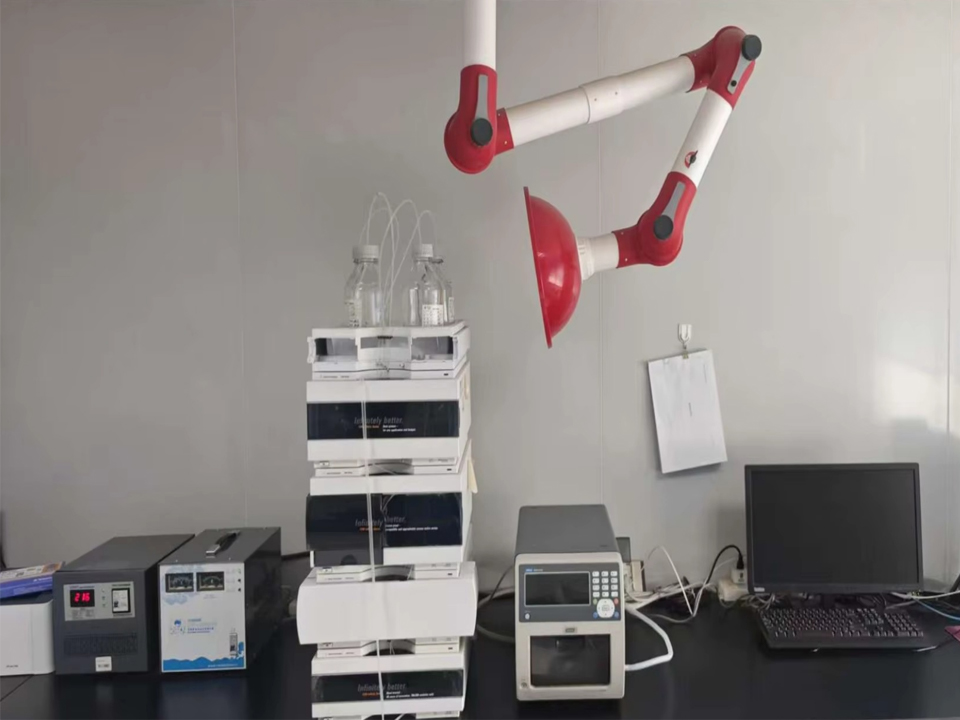
HPLC, short for high-performance liquid chromatography, is a widely used technique for botanical marker analysis. Laboratories may use other suitable methods depending on the ingredient and target compound.
But the instrument alone doesn’t guarantee a reliable result.
We’d want to know whether the analytical procedure can identify and measure the specified constituent accurately in that particular extract.
We’d also check the reference standard, reporting basis, acceptance limits, and actual lot result.
A batch can pass the marker assay and still fail another quality requirement.
Too much moisture. Unacceptable microbiological results. Unexpected residual solvents.
Standardization doesn’t make those risks disappear.
What Do Standardized Extract Percentages Actually Mean?
Let’s put the terminology aside for a moment and work through the numbers.
Suppose you’re formulating a capsule with 200 mg of botanical extract. Your supplier specifies that the extract contains 5% of a named marker compound.
Here’s the calculation:
200 mg × 5% = 10 mg
Your 200 mg extract portion nominally contributes 10 mg of that marker when the material meets the stated 5% assay.
Straightforward.
But you can’t make that calculation responsibly until you confirm what the supplier means by 5%.
Does it represent one compound? Total flavonoids? A group of saponins? A minimum content specification?
And does the test method support the reported value?
Those details determine whether the number is useful.
The assay needs to identify what the reported total isoflavone value includes
These are examples of supplier-listed grades, not independently verified batch results. Product-specific values require current specifications and batch certificates of analysis.
The product offers grades with at least 20%, 40%, and 50% Mogroside V.
If a 20% grade meets its minimum assay, 150 mg supplies at least 30 mg of Mogroside V. A 50% grade needs only 60 mg to supply that same minimum quantity.
Same calculated marker amount. Much less ingredient weight.
Does that make the 50% grade the obvious choice?
Not necessarily.
For a beverage formulation, we’d also consider sweetness intensity, sensory profile, solubility, other mogrosides, and any carriers. Two extracts can deliver the same calculated Mogroside V content while behaving differently in the finished drink.
The listed ratio grades include 10:1 and 20:1. Separate standardized grades specify 10%, 20%, and 30% polyphenols.
A 20:1 extract ratio doesn’t mean 20% polyphenols.
You can’t convert one figure into the other without additional analytical information.
Could a single extract have both specifications? Absolutely.
A supplier might define the extraction ratio and also guarantee a particular marker concentration. Both values need their own supporting evidence.
Is Whole Herb Powder Inferior?
Not automatically.
There’s a common assumption that concentrated extracts represent an improvement over whole botanical powders.
Sometimes they do provide advantages. Sometimes the original powdered material better matches the product concept.
Suppose you’re developing a formula around a particular whole botanical ingredient rather than a concentrated marker.
Replacing it with an extract changes the material’s composition. It may also change dosage calculations, processing behavior, sensory characteristics, and labeling requirements.
A standardized extract offers more explicit control over selected constituents.
A whole botanical powder retains the original milled material.
A ratio extract represents another approach entirely.
We’d choose the format that matches the intended formulation and supporting technical evidence, rather than treating one category as universally superior.
Does a Higher Standardized Percentage Mean Better Quality?
Here’s the thing about high assay numbers.
They look convincing.
A supplier advertising 50% of a marker may appear to offer a better ingredient than another supplier selling 20%.
And if both grades use comparable analytical methods, the 50% material does contain more of that specified constituent per unit of extract.
But that alone doesn’t settle the purchasing decision.
We still have to ask:
Are both extracts derived from the same botanical species and plant part?
Are the values determined using comparable analytical methods?
Do the extracts contain different carriers or processing aids?
Has either ingredient demonstrated better stability in the intended formulation?
Does the higher concentration match the technical basis of the product design?
There’s also the processing side.
A highly concentrated extract might reduce the amount of material needed per serving. That’s useful when you’re trying to fit several ingredients into a capsule with limited fill capacity.
But what if the more concentrated grade absorbs moisture more readily? What if it doesn’t blend evenly with the other ingredients? Or costs substantially more without offering a formulation advantage?
Then the higher number may not help.
Our preferred approach would be to define the formulation requirement first and evaluate concentration second.
Not the other way around.
Why a 98% Extract Still Requires Careful Evaluation
Ninety-eight percent sounds almost like a pure substance.
But gypenosides refer to a group of related saponins, not necessarily one isolated molecule.
That raises an immediate analytical question.
How did the laboratory determine the reported total?
Different testing approaches can define and quantify compound groups differently. Without knowing the method and reference basis, we can’t automatically compare a 98% value from one supplier with another supplier’s reported assay.
A high percentage may represent a useful ingredient specification.
It doesn’t, by itself, establish the full chemical profile, botanical identity, contaminant status, or manufacturing suitability.
We’d rather evaluate a well-documented specification with a defensible assay than chase the highest number on a sales sheet.
How Can Buyers Verify Whether an Extract Is Truly Standardized?
Start with the certificate of analysis.
Then keep going.
A COA provides information about a particular production lot. It should connect the material to its specification and report the relevant analytical results.
But not every COA offers the same level of detail.
A document that says only “Assay: 20% — Pass” leaves us with obvious questions.
Which analyte? Which method? What were the acceptance limits? Does the batch number match the delivered material?
That’s why we look at the full technical package rather than one assay line.
What Should a Botanical Extract COA Include?
Quality parameter
Information to request
Why it matters
Botanical identity
Scientific name and plant part
Confirms the declared botanical source
Marker specification
Exact compound or defined group
Clarifies the meaning of standardization
Assay result
Actual batch value and acceptance limit
Demonstrates whether the batch meets the specification
Analytical method
Method identification and appropriate validation details
Allows meaningful interpretation of the result
Extract composition
Native extract, carriers, and processing aids
Helps establish the actual formulation input
Microbiological quality
Relevant microbial results and limits
Supports manufacturing quality review
Elemental contaminants
Applicable heavy-metal results and limits
Supports contaminant assessment
Residual solvents
Results for relevant extraction solvents
Supports process and quality evaluation
Batch traceability
Lot number, test date, and supplier details
Connects the document to the delivered material
Some suppliers provide these details across several documents rather than putting everything on one COA.
That’s fine, provided the information is complete, relevant, and traceable.
If the specification lists total isoflavones, we’d ask which compounds contribute to that total and how the laboratory measures them.
The same question applies to products standardized for total flavonoids, polyphenols, or saponins.
A broad chemical category isn’t automatically a precisely defined assay.
Why Analytical Methods Matter
You’ll see HPLC mentioned constantly in botanical extract specifications.
And for good reason. The technique can separate and quantify selected chemical constituents with considerable specificity when laboratories apply an appropriate method.
But “HPLC tested” isn’t enough information to approve an ingredient.
We’d ask whether the method suits the target compound and extract matrix, whether the laboratory uses suitable reference standards, and how it addresses potentially interfering substances.
What about broader chemical profiles?
Sometimes an analytical fingerprint helps provide supporting evidence about botanical identity and composition beyond a single marker assay.
Under the applicable dietary supplement CGMP requirements, manufacturers generally must perform at least one appropriate identity test or examination for dietary ingredients unless they qualify for an FDA-approved exemption.
They may rely on qualified suppliers’ COAs for certain other component specifications under the applicable conditions.
In other words, a supplier’s COA can support your quality system, but it doesn’t automatically replace your own responsibilities.
What Quality Risks Can Standardization Leave Unaddressed?
A standardized extract can meet its assay specification and still create problems.
That’s not a contradiction.
The assay measures particular constituents. Manufacturing quality covers a much wider set of characteristics.
Botanical Identity and Composition
Let’s say two extracts contain the same percentage of a particular marker.
Does that mean they came from the same plant species?
Not necessarily.
Some constituents occur in more than one botanical source. An individual marker may therefore tell us something about composition without conclusively identifying the plant.
For certain ingredients, a buyer may need botanical authentication, chromatographic fingerprinting, or other appropriate identity testing.
Then there’s adulteration risk.
If a supplier adds an isolated compound to raise a reported assay, the final number may look attractive while concealing a materially different ingredient composition.
A strong QC program needs to consider risks that the chosen marker test alone cannot detect.
Physical Properties and Manufacturing Performance
Here’s a practical manufacturing scenario.
Two extracts arrive with the same declared standardized assay. Both satisfy the required marker specification.
Supplier A’s powder flows smoothly through the capsule-filling equipment.
Supplier B’s material absorbs moisture, cakes during storage, and bridges in the hopper. Operators have to interrupt production to keep the material feeding properly.
Chemically, the headline assay looks comparable.
Operationally? Not even close.
The example illustrates why we wouldn’t approve an ingredient using the marker percentage alone.
Particle size, bulk density, moisture, hygroscopicity, and flowability can affect blending and capsule filling.
For tablets, we’d also consider compressibility and interactions with excipients.
A high-assay grade may look cheaper on a marker-cost basis yet become more expensive if it increases processing losses or causes repeated interruptions.
The lab result matters.
So does the production line.
Stability and Shelf Life
What happens six months after the supplier issues the COA?
That’s another question worth asking.
A passing assay at batch release doesn’t prove that the same concentration will remain unchanged throughout the intended shelf life.
Some botanical compounds may respond to humidity, oxygen, temperature, or light. Packaging and storage conditions can make a difference.
We’d want the supplier’s available stability information and recommended storage conditions before establishing shelf-life assumptions.
It applies to herbal medicinal products rather than serving as a universal legal requirement for all European food supplements.
Still, its emphasis on measurable specifications and stability provides a useful reference point for technical discussions.
How Does Standardization Affect Supplement Formulation Costs?
A lower price per kilogram doesn’t always mean a lower cost per serving.
Let’s run a hypothetical comparison.
Supplier A offers an extract standardized to 20% of a named marker at $40 per kilogram.
Supplier B offers a 50% grade at $90 per kilogram.
At first glance, Supplier A seems cheaper.
But suppose your formulation requires 30 mg of that marker per serving, and both grades use comparable analytical definitions.
Now the math changes.
Cost factor
Supplier A
Supplier B
Standardized marker content
20%
50%
Ingredient price
$40/kg
$90/kg
Extract needed for 30 mg of marker
150 mg
60 mg
Estimated ingredient cost per serving
$0.0060
$0.0054
Estimated ingredient cost per 1,000 servings
$6.00
$5.40
Microbiological quality
Relevant microbial results and limits
Supports manufacturing quality review
Elemental contaminants
Applicable heavy-metal results and limits
Supports contaminant assessment
Residual solvents
Results for relevant extraction solvents
Supports process and quality evaluation
Batch traceability
Lot number, test date, and supplier details
Connects the document to the delivered material
Illustrative calculation only. These are not actual supplier quotations, and the example assumes comparable marker definitions and suitability.
Surprising?
Supplier B charges more per kilogram but delivers a lower calculated ingredient cost per serving.
The higher-concentration grade also frees up 90 mg of formulation space in this example.
For a capsule carrying several botanical ingredients, that could be useful.
Of course, we’d still need to look beyond the calculation.
What about freight costs, MOQ, powder handling, testing expenses, or ingredient losses during manufacturing? Does the concentrated material need additional excipients? Will it remain stable in the intended dosage form?
Those factors can change the overall economics.
The number we’d focus on is the qualified cost per finished serving, not simply the quoted price per kilogram.
Avoid Comparing Different Markers as If They Were Equivalent
One supplier quotes 20% total polyphenols.
Another quotes 20% of a specific flavonoid.
A third offers 20:1 extract.
All three numbers contain “20.” That doesn’t make them comparable.
If both grades express the same HCA specification on a comparable analytical basis, we can calculate the quantities required to supply a particular nominal amount of HCA.
But we’d still verify the chemical form, assay method, and complete composition before deciding that one is a straightforward replacement for the other.
This matters especially when multiple suppliers use slightly different technical terminology.
Don’t compare price until you’ve established what each number represents.
What Should Buyers Specify Before Requesting a Quote?
“Can you quote standardized botanical extract, 25 kg?”
You can send that inquiry. You might even receive a quotation.
But will it represent the exact ingredient your formulation needs?
Probably not without further discussion.
A good RFQ removes avoidable ambiguity before the supplier begins pricing.
For standardized extracts, we’d include:
Botanical identity: Scientific name, required plant part, and any relevant origin requirements.
Target constituents: Exact marker compounds or defined constituent groups.
Standardization level: Minimum percentage or acceptable assay range, including the assay basis.
Analytical requirements: Preferred test method, reporting units, and applicable standards.
Ingredient composition: Requirements for carriers, excipients, processing aids, and other formulation components.
Physical specification: Powder form, particle size, moisture, bulk density, solubility, or other relevant processing characteristics.
Quality documentation: Current COA, technical data sheet, relevant contaminant testing, and available stability data.
Commercial requirements: Estimated annual volume, MOQ, sample quantity, packaging, lead time, delivery destination, and shipping terms.
Regulatory destination: Intended market and proposed application, such as dietary supplements or functional foods.
We’d also tell the supplier how we intend to use the ingredient.
Capsules? Tablets? Gummies? Powdered drinks?
It matters.
An extract that performs well in a dry capsule blend may create solubility, flavor, or stability challenges in a beverage system.
And a grade that passes laboratory testing may still require formulation adjustments before it runs reliably through production equipment.
The clearer your original specification, the easier it becomes to compare genuine alternatives.
How to Evaluate Suppliers Beyond the Quotation
Suppose two suppliers offer the same botanical extract at similar assay levels.
One provides a detailed specification, a batch-specific COA, a clear analytical method, and suitable technical documentation.
The other sends a price sheet with a single line reading “Purity: 95%.”
Which offer would we investigate first?
Price matters, of course. But supplier qualification requires more than an attractive number.
We’d request representative samples, review batch documentation, and arrange independent analytical verification where the ingredient’s risk profile justifies it.
We’d also ask about batch-to-batch consistency, out-of-specification procedures, change control, and traceability.
What happens if the extraction solvent changes? If the supplier switches carriers? If the next production lot falls outside the agreed assay limits?
Those aren’t minor administrative questions.
They affect whether a supplement manufacturer can maintain a consistent finished product across commercial batches.
Our preference would be a supplier who can explain the specification, support the test results, and deliver the same agreed grade repeatedly.
Not just once.
Frequently Asked Questions
1. Does standardized mean a supplement is more effective?
No. Standardization controls selected chemical constituents; it doesn’t prove clinical effectiveness. We still need to consider the ingredient’s composition, dosage, intended use, and supporting scientific evidence. A higher marker percentage doesn’t automatically produce better outcomes.
2. Is a standardized herbal extract better than a whole herb?
Not necessarily. Standardized extracts help formulators control particular marker compounds. Whole herb powders may better suit products designed around the original botanical material. We’d choose based on the formulation objective, technical requirements, and relevant evidence.
3. What does standardized to 10% mean in supplements?
It generally means the extract contains 10% of a specified marker or defined constituent group under the stated analytical conditions. For example, 300 mg of an extract standardized to 10% would nominally supply 30 mg of that constituent.
4. Is a 20:1 extract stronger than a standardized 20% extract?
You can’t determine that from the numbers alone. A 20:1 ratio describes a botanical-to-extract relationship. A 20% standardized specification describes constituent concentration. They’re different measurements, so you need more analytical information before comparing the ingredients.
5. Can a botanical extract be both standardized and a ratio extract?
Yes. A botanical extract can have a defined extraction ratio and a separate marker concentration. The supplier should document both specifications and explain how it measures or establishes each one.
6. Is HPLC testing required for every standardized herbal extract?
Not universally. HPLC works well for many botanical marker assays, but laboratories may use other scientifically suitable methods depending on the ingredient, analyte, and applicable requirements. We’d focus on whether the chosen method reliably measures the specified constituent.
7. What documents should supplement manufacturers request from a standardized extract supplier?
Start with the ingredient specification, batch-specific COA, botanical identity records, relevant analytical methods, and contaminant results. Depending on the application, we’d also request composition details, stability information, and documentation relevant to the destination market.